
Submitted by Ronnie Hall on
This article was written by Matthew Canfield, Sabrina Masinjila, Barbara Ntambirweki, and was originally published by Agroecology Now. Central to the authors' argument is the question of who ultimately stands to benefit from this so-called “fourth agricultural revolution.” They contend, first and foremost, that data justice must be grounded in the lived experiences and livelihoods of food producers. They also emphasize that data justice for African farmers cannot be confined to the individual-rights frameworks that dominate Eurocentric privacy debates. Instead, they call for regenerative, non-extractive technological approaches and for collective sovereignty over both data and mineral resources. Ultimately, the authors argue for a human-rights-based framework for digital food and agricultural systems—one capable of challenging extractive colonial logics and ensuring that emerging technologies do not undermine efforts to build agroecological futures.
---
Across the African continent, a new trend is emerging–the integration of digital technologies into food systems. Described as the “Fourth Agricultural Revolution” by the World Bank, these “biodigital technologies” include everything from mobile phone applications and remote sensing technologies to genomic sequencing used to develop new crop and livestock varieties.
Proponents of bio-digitalization—the integration of social and biological aspects of food systems through digital technologies to optimize production—argue that such innovations can improve food security, enable climate change adaptation, and enhance rural livelihoods. They contend that the combination of vast amounts of digitally-harvested data with machine learning and artificial intelligence will yield predictive analytics and better decision-making. Yet while digital technologies could hold opportunities, they also generate significant risks through their disruptive potentials. For example, they can create new dependencies and lock-ins, deepen information asymmetries, and expand surveillance and control over food systems.
At the heart of these technologies is the data they collect. Data harvested from seeds, soils, land, farmers practices, and local knowledge fuel this digital “revolution.” Such data underpins the training sets that enable machine learning andartificial intelligence, which are increasingly being integrated into food systems. As data is collected from farmers, land, and communities there remain significant questions about who will ultimately benefit from this “revolution.”
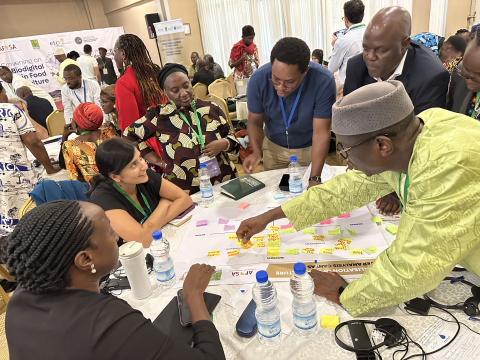
This issue was at the heart of the recent Pan-African Convening on Biodigital Technologies for Food and Agriculture, held in Addis Ababa from 2-4 October. Social movements, civil society organizations, smallholder producers, lawyers and researchers among others were convened by the Alliance for Food Sovereignty in Africa, ETC Group, and the AfricanTechnology Assessment Platform to discuss the growing presence of digital technologies and their implications for African food systems.
Rethinking data justice from the perspective of African food producers
During the Convening, participants began discussing many important questions facing social movements. These included identifying the risks that bio-digital technologies pose to African food sovereignty; whether, how, and under what conditions bio-digital technologies can enable agroecological food systems; how technology assessment processes can build capacity for social movements to make informed decisions; and, what policies can ensure that digital technologies ultimately benefit African food producers.
Participants explored the questions including: How can Africa’s small-scale food producers ensure that digital technologies, where appropriate, support their visions of ecological justice, food sovereignty and agroecological foodsystems? What policies and norms can ensure that their inclusion into digital food systems supports their equity and autonomy? What does “data justice” mean for Africa’s small-scale farmers, pastoralists and fisherfolk?
While the Declaration published after the event emphasized that “data justice and seed sovereignty are non-negotiable rights of farmers and communities,” it was also clear that movements and farmers are only beginning to articulate data justice in ways that are meaningful to them. During our discussions, three themes emerged as central for developing an African vision for data justice and digitalization rooted in food sovereignty.
First, and most importantly, it is clear that data justice must be rooted in the experiences and livelihoods of food producers.
Currently, many of the discussions around justice center around the idea that farmers should control their data. However, this understanding of “data” reflects the worldview of Big Tech, which sees data as a powerful resource because it can be extracted, combined and analyzed through algorithms and fossil-fuel consuming computational processes to generate insights useful for the owners of these infrastructures.
For farmers, however, data stripped from its social and ecological context holds little value. Farmers lack the computational power of big tech and governments, which means that controlling their data alone will not guarantee justice. More likely, it will bring additional labor that farmers have little training in.
From a farmer’s perspective, data is not an individual resource to be owned or controlled in isolation. It is embedded in their relationships—with their agroecological territories, shared resources, communities, and governments—and emerges from the questions, constraints, and challenges they confront in daily life. Data justice, therefore, cannot be universal or abstract; it must be grounded in these lived relationships.
For example, governments and corporations are increasingly quantifying soils—measuring micronutrients, carbon, andmoisture—to generate targeted fertilizer recommendations and to feed emerging soil carbon markets. While some of this information may be useful to farmers, such forms of datafication marginalizes their embodied, place-based knowledge and imposes external assumptions about both the problems and the solution. They treat soil fertility as a technical issue to be fixed through inputs rather than, as farmers might see it, challenges linked to water access or agroecological practices for retaining moisture.
Another example is digital sequence information (DSI), a term used to describe how biological samples and traits of selected organisms, such as seed, are collected from farmers and digitized into genomic data. DSI severs living materials from their ecological and cultural contexts. It privileges external, technoscientific ways of knowing over farmers’ own understandings of life, land, and seed. Beyond having little practical value to them, it also opens the door to biopiracy and the appropriation of genetic resources.
These examples reveal how abstract discussions of “data rights” ignore the epistemic dimensions of data and remain rooted in a Western, capitalist, and individualist framework of knowledge. Reframing data justice in the language of farmers therefore requires questioning what “data” is, and the knowledge, relationships, and ecologies from which it is extracted.
Agroecology offers one model of what data justice might look like. With its holistic approach, it is skeptical of scientific processes that extract uncontextualized data that reduces the complexity of ecosystems. It aims to decolonise dominant scientific and technological understandings of data and starting instead from African systems of research, evaluation, and place-based knowledge and relations to land.
Agroecology also recognizes farmers’ extensive place-based, ecological knowledge—embracing co-creation and co-inquiry as a central tenant of research. It includes farmers and their organizations as co-researchers and co-owners throughout the research process–from data collection to analysis–and ensures that findings address their actual needs and lead to technologies and innovations that benefit them. Such practices and the principles of agroecology can be a blueprint for data justice.
Second, data justice for African farmers cannot be limited to the individual rights frameworks dominant in Eurocentric approaches to privacy. Currently, the primary frameworks regulating data extraction is privacy law. Over the past two decades, more than half of African states and the AU have adopted data privacy laws, as has the Economic Community of West African States (ECOWAS). While such legal frameworks are critical in a wide range of fields in which data-driven technologies are currently being introduced, such frameworks are drawn from European regulatory models, which are premised on the distinction between personal and non-personal data.[1] Personal data requires strict protocols and informed consent to be collected and shared. By contrast, farm data is classified as non-personal data,which lacks such stringent protocols.
Such an approach not only fails to deal with the reality of farm data, it also overlooks the collective dimensions of agricultural data. This is particularly true for African small-scale farmers whose land, seeds, and knowledge are considered commons, and shared among families and communities.
From a farmer’s perspective, collective rights and claims are often more significant because they address structural issues of power, including economic, gender, and global inequalities. They also respond to ecological challenges such as the unequal impacts of climate change, the loss of biodiversity, and restricted access to water. Data justice for African farmers is therefore inseparable from their broader human rights to food, to land, and to culture.
There are already African governance frameworks that further a collective approach. An example is the African Union Convention on Cybersecurity and Data Privacy is one of the only documents on privacy that addresses the rights of local communities. In addition, the African Charter on Human and People’s Rights (Banjul Charter) speaks to the right to self-determination and the duty to exercise rights taking into account ‘family and society’ ‘collective security’ and‘ common interests’ as provided under Articles 20 and 27.
Seeking balance between individual and collective rights is, of course, a challenge. African societies are rapidly changing, and digital technologies play a major role in that transformation. Individual privacy remains vital, but alone it cannot address the structural and ecological issues facing small-scale food producers. Developing models for the operationalization of collective rights therefore remains central to advancing data justice in African food systems.
Finally, focusing on just data is too limited to address the inequalities generated by digitalization.
Data justice for farmers must therefore extend to the entire system through which data-driven technologies are designed, built, and deployed. Central to this justice is recognizing not only control over farm data but also the material foundations that enable digital infrastructure. A critical yet frequently overlooked dimension of digital technologies is their profound reliance on minerals. The expansion of digital and AI infrastructures is inseparable from the extraction of Africa’s vast natural resources—cobalt, coltan, copper, lithium, and rare earths—that power devices, data centers, and computational systems worldwide.
This extraction perpetuates colonial patterns of resource exploitation, with African environments and communities disproportionately bearing the environmental, social and economic costs of global technological expansion. Mining activities often exacerbate land grabs and ecological degradation fueling violent conflicts as seen with cobalt mining in the Democratic Republic of Congo (DRC) where access to minerals necessary for digital technology has become a major factor in ongoing humanitarian crises. While Africa holds approximately 30% of the world’s “critical mineral” reserves,communities rarely benefit. Instead affected communities often face pollution, violence, human rights abuses, unsafe labor conditions and forced evictions.
The Pan-African convening explicitly called out this connection, demanding non-extractive, regenerative technological approaches and collective sovereignty over both data and mineral resources.
Towards a human rights-based approach to digital food and agricultural systems
Data extraction has, for generations, served as a tool of colonial control; research on African communities by foreign officials, academics, and researchers have produced information and knowledge asymmetries that long have enabled everything from colonial administration to resource extraction to contemporary forms of political and economic control.
As new bio-digital technologies extract data from African farmers, producers, consumers, and ecosystems, that Africans neither control nor have the computational power to analyse, there remain significant questions about whether these new technologies can truly benefit African farmers or whether they will simply be a new colonial frontier. In this context, it is urgent to develop human rights-based approaches to data extraction.
Developing a human rights-based approach to data cannot be limited to a right over or to control data. The language of “data” itself already imagines that knowledge can be extracted from its social and ecological context, commodified, and sold. Instead, human rights must be rooted in the dignity of everyday human activities and relations among people, societies and natural resources. They should, first and foremost, protect these activities and relations from domination, disappearance, or degradation. To do so, they must put those most affected at the center of decision-making.
The Pan-African Meeting marked an important moment in which farmers movements, networks, and organizations are now beginning to articulate a human rights-based approach to digital agriculture rooted in their cultures, practices, and worldviews.
---
[1] Personal data, according to Article 1 of the AU Convention, is defined as “any information relating to an identified or identifiable natural person by which this person can be identified, directly or indirectly in particular by reference to an identification number or to one or more factors specific to his/her physical, physiological, mental, economic, cultural or social identity.” This definition is consistent with most definitions of personal data drawn from European regulatory models. It also reflects the way “personal data” is defined in most legal frameworks in Africa, which largely reflects European influence or what scholars have termed the “Brussels effect” of global data law and policy.