Potential Impact of GURTs on Smallholder Farmers
Enviado por ETC Staff el
This document is referenced in the ETC News Release: "Broken Promise? Monsanto Promotes Terminator Seed Technology" of 23 April 2003
Enviado por ETC Staff el
This document is referenced in the ETC News Release: "Broken Promise? Monsanto Promotes Terminator Seed Technology" of 23 April 2003

Enviado por ETC Staff el
México acaba de firmar un acuerdo con Estados Unidos y Canadá para burlar los requerimientos del Protocolo de Bioseguridad internacional y promover que sigan entrando en territorio mexicano granos contaminados con transgénicos, librando de responsabilidad a empresas y países que los producen. El acuerdo fue signado el pasado 29 de octubre por Víctor Villalobos, de la Secretaría de Agricultura de México (Sagarpa); J. B. Penn, del Departamento de Agricultura de Estados Unidos, y Andrew Marsland, del Ministerio de Agricultura y Agroalimentos de Canadá. México promueve además que el acuerdo se extienda a otros países latinoamericanos. Según Blair Commber, director de Agricultura de Canadá, Argentina, Brasil y Uruguay ya han manifestado su interés.
Enviado por ETC Staff el
Más de la mitad de las mayores economías del mundo son corporaciones transnacionales y no países.(1) Las transnacionales tienen un poder sin precedentes para influir en las políticas sociales, económicas y de comercio. La hegemonía corporativa está usurpando el papel y las responsabilidades de los gobiernos, amenazando la democracia, y los derechos humanos. El Grupo ETC (anteriormente RAFI) ha monitoreado el poder corporativo y las tendencias que siguen las "ciencias de la vida" durante las dos últimas décadas.
Enviado por ETC Staff el
Over half of the world's 100 largest economic entities are transnational corporations (TNCs), not nations. TNCs have unprecedented power to shape social, economic and trade policies. Corporate hegemony is usurping the role and responsibilities of national governments, threatening democracy and human rights. Over the past two decades ETC Group (formerly as RAFI) has monitored corporate power and trends in the "life sciences." Consolidation, technological convergence and non-merger corporate alliances are among the trends examined in this issue of ETC Communiqué.
An open letter to Mexican government authorities and intergovernmental bodies was sent, signed by 302 organizations from 56 countries, demanding actions to stop contamination of farmers' maize with DNA from genetically modified (GM) maize, and to prevent any further contamination in the world's centers of crop diversity and origin. The open letter, see "Open letter from international civil society organizations, News Release; November 19, 2003" asks the Mexican government to maintain the moratorium against the planting of transgenic maize in Mexico, stop the importation of transgenic or non-segregated maize - likely the main source of contamination in Mexico- and conduct urgent studies to determine the extent of the contamination.
Enviado por ETC Staff el
An open letter to Mexican government authorities and intergovernmental bodies was sent today, signed by 302 organizations from 56 countries, demanding actions to stop contamination of farmers' maize with DNA from genetically modified (GM) maize, and to prevent any further contamination in the world's centers of crop diversity and origin.
Enviado por ETC Staff el
En el día de hoy, 302 organizaciones de 56 países del mundo enviaron una carta abierta a las autoridades mexicanas y organismos internacionales, exigiendo que se tomen acciones para parar la contaminación del maíz campesino con ADN modificado genéticamente y prevenir que se sigan contaminando los centros de origen y diversidad de los cultivos en el mundo.
Enviado por ETC Staff el
Terminator – or genetic seed sterilization – has been on the agenda of the United Nations’ Convention on Biological Diversity (CBD) for five years. If the Gene Giants and governments get their way, the CBD will be conducting studies on Terminator for years to come – long after suicide seeds are commercialized and show up in farmers’ fields.
At the ninth meeting of the CBD’s scientific advisory body (SBSTTA 9) held November 10-14 in Montreal, four governments – Canada, New Zealand, Argentina and Brazil – were allowed to highjack debate and stall action on Terminator by insisting that the CBD postpone consideration of an expert technical report on the impacts of genetic seed sterilization, arguing that the report lacks scientific rigor. While the report will be forwarded to next February’s Conference of the Parties (COP7) in Kuala Lumpur, Malaysia, it will go with a recommendation that COP7 forego action and re-direct the report to the next meeting of the scientific body (SBSTTA10) – in late 2004 or 2005 – with the aim of providing advice to COP8 in 2006!
Enviado por ETC Staff el
Refiriéndose a la contaminación del maíz campesino en México, Michael Phillips, director ejecutivo de la Organización de la Industria Biotecnológica de Estados Unidos (BIO), recomendó el 10 de octubre pasado, en una entrevista a Mark Schapiro en The Nation, rendirse ante las evidencias y abrirse alegremente a la contaminación: "Si usted fuera el gobierno de México, espero que haya aprendido la lección: es muy difícil contener una nueva tecnología para que no pase sus fronteras, especialmente en un sistema biológico... ".
Enviado por ETC Staff el
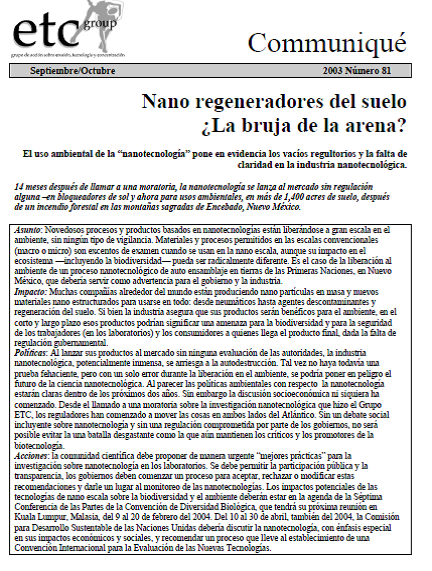
ETC Group today (October 2003) released a 6-page Communiqué on the use of nanotechnology-based products in the environment - products that are coming to market in the absence of both government oversight and public discussion. A recent large-scale application of a product touted to control soil erosion using nanotechnology highlights regulatory inadequacies and lack of clarity in the nanotech industry.
Nanotechnology - whose best-known commercial successes have thus far been stain-resistant fabrics, stronger and lighter tennis rackets, and transparent sunscreens - has spawned new environmental products to prevent erosion or to clean up contaminated sites. While the companies claim these products will be beneficial to the ecosystem, in the absence of government regulatory oversight, the unknown short- and long-term implications raise concerns for health and for the environment.
Enviado por ETC Staff el
To the Mexican government and the international community:
On October 9, 2003, peasant farmers and indigenous communities, along with civil society organizations in Mexico, publicly released the initial results of their own testing that found GM contamination of native maize in at least nine Mexican states, even though the planting of transgenic maize is prohibited in Mexico. These results , which are part of ongoing studies, show far more serious and widespread contamination than previously assumed by earlier studies (e. g., the study by Berkeley scientists Chapela and Quist and one by the official Institute of Ecology in Mexico.
One alarming fact is that the communities found widespread contamination with Starlink maize (not approved for human consumption in the US and finally taken off the market) and contamination of single plants with up to three different transgenes, which may indicate that contamination has been occurring over several generations. All identified sequences are patented by one of the five multinationals that control the agricultural biotechnology industry.
Enviado por ETC Staff el
Al Gobierno Mexicano y a la comunidad internacional.
El 9 de octubre del 2003, campesinos y comunidades indígenas, junto con organizaciones de la sociedad civil en México, publicaron los resultados iniciales de sus pruebas sobre la contaminación de las variedades nativas de maíz en al menos nueve estados, aunque la siembra de maíz transgénico está prohibida en México. Los resultados, que son parte de más estudios en curso, mostraron que la contaminación es mucho más grave y está mucho más extendida que lo que se pensaba anteriormente (por ejemplo en el estudio de los científicos Chapela y Quist de Berkeley y del Instituto Nacional de Ecología en México).
Un hecho alarmante es que encontraron contaminación con maíz Starlink (prohibido para el consumo humano en Estados Unidos y finalmente retirado del mercado) y plantas contaminadas con hasta tres transgenes diferentes, lo que podría indicar que la contaminación ha estado ocurriendo desde hace varias generaciones. Todas las secuencias identificadas están patentadas por alguna de las cinco multinacionales que controlan la industria biotecnológica agrícola.
Enviado por ETC Staff el
Veinticinco meses después de que se publicó la primer evidencia científica, el gobierno mexicano y la comunidad científica reconocen que, el maíz, principal cultivo de México, está contaminado con ADN de maíz genéticamente modificado, a pesar de que en ese país está prohibida la siembra de maíz transgénico. México es centro de origen del maíz, uno de los cultivos alimentarios más importantes del mundo.
Enviado por ETC Staff el
On October 9, 2003, peasant farmers and indigenous communities along with civil society organizations in Mexico publicly released the results of their own testing of farmers' maize varieties and found GM contamination in at least nine states - far more serious and widespread than previously assumed.
Enviado por ETC Staff el
Mexico City, Mexico
* Contamination has been found in cornfields in the states of Chihuahua, Morelos, Durango, Mexico State, Puebla, Oaxaca, San Luis Potosí, Tlaxcala and Veracruz
* Analyses show contamination with the genetically modified (GM) variety Starlink, prohibited for human consumption in the United States
* Some plants found to show presence of two, three and four different GM types, all patented by transnational biotechnology corporations
Enviado por ETC Staff el
Contaminación también en Chihuahua, Morelos, Durango, Edomex, Puebla, Oaxaca, San Luis Potosí, Tlaxcala y Veracruz
Encuentran en todos contaminación con Starlink, variedad prohibida para consumo humano en Estados Unidos
Dos, tres y cuatro diferentes transgénicos en la misma planta, todos patentados por transnacionales biotecnológicas
Las comunidades indígenas y campesinas toman el proceso en sus manos, demandan parar importaciones de maíz, mantener la moratoria al maíz transgénico y detener la ley de bioseguridad en discusión en el Congreso.
Enviado por ETC Staff el
Unique nanotechnology products and processes are entering large-scale use in the environment without regulatory oversight. Materials and processes approved at conventional scales (macro or micro) do not require re-examination when used at the nanoscale even though the impact on the ecosystem – including on biodiversity – could be radically different. A recent event on First Nations’ land in New Mexico using what appears to be a nanotech self-assembly process should be a warning to government and industry.
Enviado por ETC Staff el
14 meses después de llamar a una moratoria, la nanotecnología se lanza al mercado sin regulación alguna -en bloqueadores de sol y ahora para usos ambientales, en más de 1,400 acres de suelo, después de un incendio forestal en las montañas sagradas de Encebado, Nuevo México.
Enviado por ETC Staff el
A más de dos años de que se conoce que existe contaminación transgénica del maíz campesino en México, centro de origen del cultivo, el gobierno mexicano, no ha hecho nada constructivo para enfrentar el tema, ni para establecer responsabilidades, ni para par
Enviado por ETC Staff el
Trece millones de personas en Lesotho, Malawi, Swazilandia, Zambia, Zimbabwe y Mozambique están amenazadas de hambruna, debido a la sequía extrema, epidemias y "mala administración política", según la FAO. Hubiera sido apenas una noticia más -pese a ser terrible-, de no ser porque varios países se negaron a recibir la ayuda alimentaria del Programa Mundial de Alimentos (PMA) por contener maíz transgénico. Esto desató un virulento debate internacional. Estados Unidos y su agencia para el desarrollo (USAID) censuraron duramente a estas naciones, que según Colin Powell, en su discurso ante la cumbre de Desarrollo Sostenible en Sudáfrica, "condenan a sus poblaciones al hambre" al no aceptar transgénicos.
Para saber más sobre el Grupo ETC o para contactarnos.